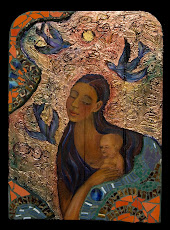
Susan Boyle stepped onto the stage for Britains Got Talent show today. Frumpy, 47 years old and volunteering that she'd never been kissed, Boyle unwittingly primed the audience to expect her to fill the "self-deluded wannabe" slot where the Got Talent staff interject awkward contestants for comic relief.
Wow - did Susan Boyle rock the house!! She surprised everyone with her rendition of I Dreamed a Dream, from Les Miserables. Watch her video and see for yourself. I got chills watching Susan realize her dream as she sang the audience to their feet.
When youth and beauty are sliding into the rearview mirror (or are firmly behind us) many of us put our dreams aside and resign ourselves to the "reality" of our lives. Thank you Susan for inspiring all of us to have the courage to reach out to our dreams. May you have a blessed creative career.
Read the BBC article about Susan Boyle for more information.
www.CristinaAcosta.com
Wednesday, April 15, 2009


Thursday, April 2, 2009
Bid on this Painting and Help a Non-Profit!

Arts education gives young people not only an opportunity to play with art materials and enjoy their school day, art education develops the creative right hemisphere of the brain. And we need more creative thinkers. The tough challenges in this new economy of global financial troubles paired with the environmental concerns of global climate change predict a future that's going to take a lot of courage and creativity.
The tiny town of Sisters, Oregon (about 20 minutes from Bend, Oregon) has an amazing philanthropic community. The Sister's Folk Festival organization organizers a fund raiser for arts in education called My Own Two Hands. Artist's from the Central Oregon area donate original paintings, sculptures, musical instruments and more for the event.
Because I enjoy the birds visiting my bird feeders, I painted a original acrylic painting in my Paint Happy style titled, Something Wild Outside My Window. My painting is on display at High Desert Gallery (they represent my work locally).
Bid on this painting (or any of the other beautiful pieces by other artists). Not only will you have a beautiful piece of original art and a tax deduction, you will be supporting the arts.
_________________________
P.S. (After the party) THANK YOU!!! The My Own 2 Hands fundraiser was a fun party. Great music, great food, lots of local art to bid on and best of all -- fun people!! Thank you to the winning bidder of my painting. Your generous bid will support the arts programs in Sisters, Oregon.
P.S. (After the party) THANK YOU!!! The My Own 2 Hands fundraiser was a fun party. Great music, great food, lots of local art to bid on and best of all -- fun people!! Thank you to the winning bidder of my painting. Your generous bid will support the arts programs in Sisters, Oregon.
Monday, March 30, 2009
Staging Your Home Can Sell it Faster
Today's real estate market is a buyer's market. Presenting your home for sale puts you in competition with an incredible amount of inventory. Look in most any neighborhood and you'll often find a combination of bank sales, short sales and regular sales. Standing out positively among the crowded MLS Multiple Listing Service pages takes special attention to detail.
Many years ago I had a Real Estate License. I sold residential resort real estate in Southern California for a couple of years before going to college to complete my training as an artist. I learned many things from that experience, including this realization: Selling real estate was no fun for me, but I loved to look at houses. It's no surprise that years later I developed my color consulting business in Bend, Oregon, as part of my creative work. Home design is a passion of mine.
Last weekend I staged a client's home in Portland, Oregon. The young family has lived in the home for about 7 years (2 children and a dog). They've had wonderful luck in this location and experienced a happy family life. Their good fortune has resulted in a move to another area, and they were ready to sell their home. They wanted to be sure that their home conveyed a clean, warm and well-cared-for first impression that would welcome buyers.
You can see a fly-around video of the home at this link http://tour.circlepix.com/tour.htm?id=719435&mls_tour=1 or, view the Portland, Oregon family home for sale on the John L. Scott Real Estate website.
Keep in mind this concept when you stage your home. When you style or stage your home for sale, you are creating home design that barely whispers your presence while it loudly invites the visitor to imagine themselves living in your home. You want to create a similar feeling to the one you get walking into a well appointed hotel suite or rental house, only with a bit more personality.
Here are a few staging tips to help you sell your home:
For assistance with home staging, home styling and decor ideas in the Central Oregon or Portland, Oregon areas, call me for a consultation 541-388-5157. I also include color consulting as part of this service.
Many years ago I had a Real Estate License. I sold residential resort real estate in Southern California for a couple of years before going to college to complete my training as an artist. I learned many things from that experience, including this realization: Selling real estate was no fun for me, but I loved to look at houses. It's no surprise that years later I developed my color consulting business in Bend, Oregon, as part of my creative work. Home design is a passion of mine.
Last weekend I staged a client's home in Portland, Oregon. The young family has lived in the home for about 7 years (2 children and a dog). They've had wonderful luck in this location and experienced a happy family life. Their good fortune has resulted in a move to another area, and they were ready to sell their home. They wanted to be sure that their home conveyed a clean, warm and well-cared-for first impression that would welcome buyers.
You can see a fly-around video of the home at this link http://tour.circlepix.com/tour.htm?id=719435&mls_tour=1 or, view the Portland, Oregon family home for sale on the John L. Scott Real Estate website.
Keep in mind this concept when you stage your home. When you style or stage your home for sale, you are creating home design that barely whispers your presence while it loudly invites the visitor to imagine themselves living in your home. You want to create a similar feeling to the one you get walking into a well appointed hotel suite or rental house, only with a bit more personality.
Here are a few staging tips to help you sell your home:
- Have on hand: Moving boxes, tape and markers. Prepare a space in the garage or other storage area to store the filled boxes. Uniform sized boxes are easier to stack.
- Clear out storage areas and closets to about half full. Arrange items that are left so that they occupy the space without filling it full. Buyers like to open cabinets and closets - make the shelves look spacious.
- Empty full bookshelves to about 10% to 30% of their former selves. Arrange remaining books with decor items to add interest.
- Hide and/or lock away any valuables including prescription drugs.
- Remove family photos - including any refrigerator photos and notes.
- Ask yourself if you can remove any furniture in the room to increase the sense of spaciousness. Be strict with yourself, you can always add pieces back.
- Remove any broken or damaged things from the room.
- Repair any broken or damaged parts to the room including: replace cracked windows, fill nail holes and touch-up wall and trim paint, replace caulking in bathrooms and kitchen if needed, clean and restore flooring as much as possible.
For assistance with home staging, home styling and decor ideas in the Central Oregon or Portland, Oregon areas, call me for a consultation 541-388-5157. I also include color consulting as part of this service.
Thursday, March 26, 2009
Fairey Fudged! The Garcia and Fairey Copyright Incident


How much of an image does an artist have to change so that they are not infringing on another artist's copyrights? Can you take an image off the internet, change a few things then call the image yours?
Usually, egregious copyright problems involve businesses deciding to "save money" by stealing an image without payment to the creator of that image, then using that image in their marketing, manufacturing or sales process. I wrote an entry about Orphan Works legislation and copyright regarding an incident where the multinational corporation Virgin used a family photograph in an international ad campaign.
Now, two artists are in a legal tussle over just such an issue, and it's about an image you may easily recognize: An Obama poster titled HOPE. The graphic poster was created by Shepard Fairey from the work of freelance photographer Mannie Garcia, who took the photograph the poster mimicked. L. Gordon Crovitz wrote a piece in the Wall Street Journal, The Fine Art of Copyright that details the incident. The New York Times also weighed in with the article by Noam Cohen, Viewing Journalism as a Work of Art.
Terry Gross, host of the NPR's, Fresh Air interviewed Fairey for the show, Shepard Fairey: Inspiration or Infringement? She aired the followup show, Mannie Garcia: The Photo that Sparked "Hope", giving the photographer an opportunity to discuss the situation.
These professional journalists have done a wonderful job covering the issue. The only thing I can add is my opinion, one I've developed through personal experience. After publication of my book, Paint Happy, I had my images stolen and had to spend a lot of money defending my copyrights.
I was curious to see the two images of the photo and poster because, words aside, the visuals speak for themselves. What struck me immediately was the sameness. Fairey's image was what I would term a stylized copy of the original Mannie Garcia photograph. Fairey cropped Garcia's image, and changed the background elements by simplifying the background to a flat color. He tilted the head so slightly that I wouldn't have noticed it as an alteration of the photograph until I listened to Fairey confidently list the tilt as one of his original contributions to the final image. I presume Fairey used a software program like Adobe Illustrator to stylize the natural colors and value transitions of the photograph into flat shapes of color.
Fairey fudged. As a professional graphic artist, Fairey knows about copyright laws. (He is quick to reveal that knowledge when Terry Gross asked about potential parodies of the HOPE poster.)
Here's what happened. He searched for images on the internet until he found an AP image he liked. He didn't bother to research anything about the creator of that image. He took the image for his own purposes without any credit or compensation to the original artist.
Fairey did not show any respect for the work of a peer. He acted like a pirate then calmly explained his actions to Terry Gross as being innocent of anything more than accidental oversight. Only Fairey knows if he would have ever told the truth if this hadn't come to light.
The latest news is that Mannie Garcia is now selling signed prints of the photograph. Many artists work diligently aiming for a break that launches their career to a higher level of visibility and sales. Maybe the light of truth cast on Fairey's actions will lead to increased fairness towards creators of all types. We can hope.
(Thanks Mannie for permission to use these 2 images for this blog entry.)
www.CristinaAcosta.com
Friday, February 27, 2009
Sketchbook: Drawing a Portrait in Pen

Drawing weekly from life is my artistic touchstone. I love working in a peaceful room with other artists. Our figure drawing group, run by artist Dawn Emerson at C.O.C.C, is a happy one. Mostly it's quiet, with Dawn's eclectic music playing as background music. But sometimes there's cheerful banter between artists and the model.
During each session we start out with 2 minute drawings and end up with poses that are about 30 minutes long at most.
Today I glanced to my right and noticed that the artist sitting next to me had a beautiful profile. So, while he concentrated on the model, I took a break from drawing the model and drew him. His name is Tripp. The drawing is ink on paper.
www.CristinaAcosta.com
Tuesday, February 24, 2009
How to Keep Working when Sales Drop

Staying inspired enough to work when there is little in the way of art sales can be a challenge. I've been an artist for a over 2 decades and have had to adjust to this challenge more than once over the years. With the dire economic reports now dominating the news, keeping up my enthusiasm and inspiration to work is more of a challenge than during good economic times when commissions, exhibits and sales opportunities kept the money coming.
Here are a few things I do to keep inspired when times are tough:
- Keep up my exercise/sports routine. In fact - I look for an exercise goal like a race or strength goal to focus on. It's often easier to see results within a couple of months from an exercise routine than from work.
- Pay attention to nutrition. Eat and drink moderately.
- Find consistent time to work on my creative work and stick with my self-imposed discipline.
- Look at the work of other artists -- both present and past. Support other artists with encouraging notes or comments. When I can -- buy gifts from artists and artisans who make their own work.
- Be on the lookout for new experiences and insights to "fill the well". Even if I can't travel, I'll explore a subject or place on the internet. Or I'll make an effort to experience a well traveled path in a different way.
- If I have to stop working on my art for a while to find other work that results in more immediate money, I make sure to fit some sort of creative activity into every day. This really helped when I had a baby and realized that my time was no longer my own. With this attitude I was able to slip back into the habit of my artwork without a lot of trouble.
Read more on my website: www.CristinaAcosta.com
Thursday, February 19, 2009
Sketchbook: A Pencil Portrait from Life
 Doing a quick sketch of a person in real life is very different than drawing from a photograph, and it's a much more pleasurable experience. Seeing and sensing the spaces around the model and picking up the mood and likeness of the person is a fun and interesting "game". Poses in a life drawing session are usually as short as a minute or 2 and as long as an hour or 2.
I especially enjoy the challenge creating a sketch of a person entails. I concentrate on sensing every relationship both visual and kinesthetically, then recording those sensations as I draw. If you want to get better at drawing, there is no substitute for drawing a real-life model -- no photos or videos. Photos and videos are great reference for the experienced artist, but for the person wishing to use sketch time as a time to hone the craft of drawing, real life is the only thing to work with.
This graphite 6B pencil sketch on a drawing tablet was about a 10 minute sketch. I do a lot of sketches that don't work out, so even though the 10 minutes involved in this sketch may seem like a simple thing, when I factor in all of my less successful explorations and experiences, the time is a lot longer.
www.CristinaAcosta.com
Thursday, February 12, 2009
Happy Valentines Day!
 Hearts are a theme I work with a lot in my work, regardless of the style or series I'm working in. Maybe my obsession with the heart motif is a Chicano artist thing, though I didn't think about the Chicano/a artist aspect of the corazon (heart) image until I noticed that I've been into the heart image for years. Sometimes I'll paint the heart with a realistic aspect like in my retablo, Running Meditation. In that retablo image, the heart is a winged heart sprouting a wreath of green leaves. In a recent charcoal drawing I created for the offrenda at the ASU Anthropology Museum's Dia de los Muertos exhibit, the heart image is created from black charcoal and tinged with iron oxide chalk.
This painting is completely, wildly happy. After I had a child and realized that the early years of our marriage (the honeymoon stage) were over and we'd moved on to something new as parents, I painted this. In a certain sense it's not only commemorative for me, but also an inspiration to remember the fun and light-hearted moments my husband and I can still enjoy with each other. Hearts and flowers and dancing on the bed (metaphorically) are the theme of this happy piece I titled, The Honeymooners. It's an acrylic and pastel 30" x 22" painting from my Paint Happy series, the same series I focused on in my book, Paint Happy.
Though this painting has been hanging in my home for years, the original is for sale.
Tuesday, February 10, 2009
Sketchbook: Drawing a Portrait

People are one of my most favorite things to draw. I love the expressions of energy and personality the body conveys whether moving or still.
Lately I've been going back to my artistic roots to redefine the direction of my artwork. Reconnecting with the discipline of figure drawing is kind of like getting back into an advanced exercise program. It takes me a little time to readjust my eye hand coordination so that every move of my hand expresses the feelings and sensations my eyes and mind coalesce.
I've been dropping in on figure drawing sessions at our local college, with a sketchbook and drawing tools. I prefer graphite pencil, charcoal and roller-ball point pens. I especially like the permanent trail of marks the pen makes as I draw -- it's a very tight discipline.
The portrait drawing above is a pen drawing of our model, Eric.
www.CristinaAcosta.com
Saturday, February 7, 2009
Ask Cristina: Paint Happy Help

Hi! I've got your Paint Happy book and I love it! But I have a question about how to "finish" my acrylic painting since I used hard pastel on tops of the paint. Can I use the fixative you suggested for the pastels and charcoal on top of the acrylic? I don't want to use something that will damage the acrylic. I'm sorry to bother you directly, but I didn't read in your book tat you covered the entire piece with anything when you were done with it. . . I love how your book helps me express what's in my heart and get past my own self-consciousness. It gives me the courage to be bold and just Go For IT!!! . . . Thanks for your help!
Diane C.
P.S. I made a cool picture for my husband for Valentine's Day! Thanks for the inspiration and encouragement!!!
__________________________________________________________________
Dear Diane,
Thanks for your nice letter. I spray the entire painting with Spray Fixative. It doesn't hurt the acrylic. Spray fix tends to dampen down the color clarity of the hard pastels, but as they are hard pastels (Prismacolor Nu Pastel) rather than soft, traditional pastels, the paint supports the image. Therefore the damping down effect is very minimal. Good luck with your work. I'd love to see a photo of your finished piece.
Best,
Cristina
Though Paint Happy is out of print, you can purchase copies on Amazon. Click through this link and I get a small percentage of the sale to help fund my creative work.
Monday, February 2, 2009
Drawing as Thinking
 Ask most anyone (who is not an artist) to draw you a map to their favorite store. Give them a pen and paper and you'll get a map with all sorts of streets and landmarks. Ask them to doodle while talking or listening and you'll be amazed at what you'll see.
Give that same person a pencil, tell them you're an artist, then ask if they can draw. They'll usually say no. (That's been my experience.) It's time to get over the mind-set.
The truth is that anyone who can write, can draw. The eye-hand coordination necessary to shape letters and the understanding of symbols (the letters and their combination) is a form of drawing (ask any calligrapher). Making that drawing beautiful or up to whatever standard you have for yourself is a different subject. Even if you're drawing "ugly" drawings, you're still drawing.
And -- even if the drawing is a very realistic looking rendering, it is still a map of the artist's thoughts. That is what I love so much about looking at drawings -- they are very clear representations of the artist's thought process as they looked either with their eyes, or in their mind's eye.
 So own up to the drawing you do, no matter what it looks like. Do more drawings, and when you look at them rather than assessing whether they are "good" or "bad", notice how your mind traveled and what you placed your attention upon (the reason one part of a figurative (realistic) drawing may be out of proportion compared to another part of the same drawing).
Note: Both of my drawings shown here are very different because they are conveying different things. I made the drawing of the Caring Hands to illustrate a poster for the play "Of Mice and Men". The goal for the piece was to look realistic, rustic and a little foreboding. The drawing of the Marching Man was created to illustrate a design concept related to shapes. Both of my original pencil drawings exhibit different intellectual and emotional goals.
The Marching Man drawing is available for sale through High Desert Gallery. High Desert Gallery has locations in Sisters, Oregon and Redmond, Oregon.
www.CristinaAcosta.com
Saturday, January 31, 2009
Don't Sell Your Inspiration Short
During the early years of my life as an artist, people would look at my work and often ask me, "How can you possibly part with (or sell) that painting?"
My desire to make a living from my art meant that I had to make peace with the reality that to make a living I have to sell my work. Seems like such a simple concept, but ironically many people think that creating art for money somehow sullies the purity of the art.
It is strange that art is afforded this expectation even though God/religion and money/power have been hand-in-hand for centuries. It's as though some people think that art work has no relation to real work. I know of many talented professionals in other fields who would never think of working for free or heavily discounted unless the work was pro-bono for a worthy cause. Yet, I know many artists, (including myself, before I got a clue) who will give discounts to wealthy people or corporations (who can certainly pay) for a variety of reasons that mostly boil down to low self esteem combined with a feeling of scarcity.
The fact is that in the world we live in, money is necessary to support anything. Here are a couple suggestions:
My desire to make a living from my art meant that I had to make peace with the reality that to make a living I have to sell my work. Seems like such a simple concept, but ironically many people think that creating art for money somehow sullies the purity of the art.
It is strange that art is afforded this expectation even though God/religion and money/power have been hand-in-hand for centuries. It's as though some people think that art work has no relation to real work. I know of many talented professionals in other fields who would never think of working for free or heavily discounted unless the work was pro-bono for a worthy cause. Yet, I know many artists, (including myself, before I got a clue) who will give discounts to wealthy people or corporations (who can certainly pay) for a variety of reasons that mostly boil down to low self esteem combined with a feeling of scarcity.
The fact is that in the world we live in, money is necessary to support anything. Here are a couple suggestions:
- For Collectors - Before you ask an artist for a deep discount, be aware that a synonym for discount is disregard. When you ask a creator to discount deeply (they are not some big box retailer or corporate chain) consider the possibility that you are asking them to disregard the value of their work (sometimes to the degree that the artist will have to stop working or will have to stop innovating so as to create "saleable" pieces). Be sensitive.
- For Artists - Remember that your work has value. Be aware of how your prices fit with comparable work and don't undersell or oversell yourself. It's easy to think that price alone matters. If you want to give away work, gift a non-profit agency, they are always looking for help.
Thursday, January 29, 2009
Recipe: Creamsicle Flan
 By Cristina Acosta ©2007, 08, 09 Read more of my recipes on my website, www.CristinaAcosta.com
 Creamy orange custard with a caramel topping is my variation of the traditional flan. Oranges are one of my favorite fruits and like the citrus flavors of lemon and lime, oranges are great with dense creamy dairy flavors. Read this recipe through before you make it, so you have an idea of what to expect. It's not difficult, it just has some steps that can be intimidating the first time (like making the caramel).
Growing up in Southern California there was always someone we knew who had an orange tree growing in their yard. I remember traveling through Redlands along roads bordering orchards of orange trees in full blossom. The fragrance seemed to brighten every molecule of air. This flan tastes like the scent of orange blossoms early in morning when the air is fresh.
Tools: 1 ½ qt. saucepan. Ramekins – 4 soup (10 oz) size or 8 small (5 oz) dishes; OR a 9" glass or ceramic pie pan; blender / Vitamix or food processor (or by hand with a whisk); stovetop; oven; large pan to hold water bath for ramekins or pie pan.
Time: About 15 minutes to assemble. 25-30 minutes to cook and 4 to 6 hours to cool. (Cool in refrigerator.)
Ingredients:
Caramel:
- 3 T. water
- ¾ cup sugar
- Apx. 1 T of fresh orange zest*
Custard:
- 6 eggs
- 1 14 oz. can of sweetened condensed milk
- 1 cup orange juice
- ¼ cup orange juice concentrate (from the frozen cans)
- 1 to 2 heaping T. of orange zest * (You’ll need 2 to 3 oranges to get enough zest for this recipe.)
Directions:
Caramel:
- Sprinkle orange zest on the bottom of each ramekin
- Combine sugar and water in saucepan.
- Over medium-high heat cook mixture, swirling occasionally until mixture is a clear, light to medium amber color.
Tips to Make Caramel:
- Don’t stir it. When I stir it I more easily burn the mixture.
- The mixture will go through stages of being foamy, then crusty. Keep swirling pan. (Swirl – Pick up pan off the stove and gently swirl mixture side to side and in circles)
- When the sugar mixture flattens down and becomes clear amber immediately pour into the ramekins. Swirl the mixture around the bottom and ½ way up the sides of the dishes.
- Set aside to cool.
Preheat oven to 350. Put in a large pan for the water bath. Start a pot of water boiling that will fill the pan with enough water so that when you set the ramekins in the pan the water is ½ way up the sides of the ramekin.
Custard: (I use a blender, adjust these directions for your tool of choice)
- Crack eggs into blender and turn on low to mix well (15-30 seconds). Don’t get them frothy.
- Add all other ingredients. Mix till well blended, but not foamy.
- Pour into the caramel coated ramekins and put them in the water-filled baking pan.
Bake for 25-30 minutes. With smaller size ramekins cook for lesser time. Note: custard will appear loose in the center when the time is up. Don't worry it will be solid by the time the dessert is completely chilled. Don't overcook or the final result will be rubbery.
Remove from oven and cool for 4 to 6 (or more) hours.
To un-mold the dessert:
- Set chilled ramikens in a shallow dish of warm water for a few minutes. The idea is to have the warmth of the water re-liquefy the caramel. Loosen the edge of the flan with a knife and flip the flan onto a dessert plate. Pour the caramel on top.
- Return the ramiken to warm water to re-liquefy as much of the topping as you can and pour over the flan.
Serve alone or with Hot Chocolate Cookies for a delicious contrast in flavors.
*Note: Fresh orange zest is essential to the flavor of this flan. If you don’t have a zest tool, use a cheese grater on the small-hole side. Be very careful to only get the orange part of the peel. The white part is bitter and will ruin your flan.
Vitamix is more than just a big blender. It's a powerful tool in the kitchen and a powerful tool for a healthy diet. Vitamix recipes and techniques enable you to eat up to 10 fruits and vegetables along with whole grains that are recommended by experts and you'll love the ease and simplicity of the Vitamix. |
 I Love Using My Vitamix!
Choosing Paint Colors Home Decor Licensing Who is Cristina Press Philanthropy Hand Painted Ceramics
Tuesday, January 27, 2009
Looking for the Perfect White?
Going into a paint store and asking for their best-selling white will rarely result in the best color of white for your home. Just because a certain color is a paint store employee favorite and easy sell, doesn't mean it's right for you. Take just a little extra time to choose a white and you'll be happier with the results. Here are some tips for choosing the best white wall paint color:
- If you're choosing a white trim paint color, choose the white after you've decided the wall colors in your home. Put sample color swatches of white against the other sample colors.
- For a crisp look, choose a white that pops out from your wall colors.
- For a subtle and serene look, choose a white that is soft and subtle against the wall color samples.
- Whites are either basically cool or warm (color temperature). Sometimes the paint company will tell you the color temperature on the samples. Benjamin Moore paint company has a fan deck of over 100 "whites" with either a "W" or a "C" near the color number to denote a warm or cool toned base. If it's not obvious, ask the paint store professional to point out the difference.
- Cool whites are bluish, greenish or purplish. Warm whites are yellowish, orangish or reddish. (Sorry about all of these "ish" endings, but I hope you get the idea.) Choose the color temperature you like, but be aware that a North facing or shady room will tend to turn a white to the cooler side and a sunny room will enhance warmth.
See examples of my color consulting portfolio and articles on my website.
www.CristinaAcosta.com Call me to schedule a color consulting appointment in Bend, Oregon or a phone appointment if you don't live in Oregon.
Sunday, January 25, 2009
Ricardo Montalbon - Artistic Pioneer


I was surprised and saddened to learn that the actor Ricardo Montalbon has recently passed. I subscribe to the LatinoLA newsletter (I was born in Los Angeles). The author, Abelardo de la Pena, mentioned that the actor Ricardo Montalbon died at the age of 88.
Ricardo Montalbon was admired by my family. He was a successful Latino who projected elegance and kindness during personal appearances. I always felt that the racism of the time toward Mexican Americans and Latinos in general, limited the opportunities Montalbon had to share his artistic gifts. Nontheless, I knew after reading Pauline Kael's (the late film critic for The New Yorker magazine) reviews of Montalbon, that his talent was not completely unrecognized.
The news of Ricardo Montalbon's passing reminded me of a photo I'd seen years ago in my father, Joaquin Enrique Acosta, Jr.'s box of memorabilia. My dad passed a few years ago from Alzheimer's. He was a highly educated and accomplished Chicano (rare during that time as the legacy of Mendez vs. the Board of Education resulted in most of his generation in Southern California attending sub-standard segregated schools for Mexican-Americans).
I found these photos of my dad with Ricardo Montalbon and other of the elites of the 1970's Southern California scene, including Timothy Cardinal Manning, actresses Loretta Young and Ann Blythe. My biggest surprise was to see that Oregon Senator Mark Hatfield was also part of the crowd. (I now live in Bend, Oregon). I don't know the occasion for this event. My parents went to many political/social fundraisers so I presume the event was either a fundraiser or an event in honor of something/someone.
It's beautiful how somebody I didn't know could touch my life positively. We all have that gift to be a role model for others even if we're not a famous actor. Thank you Ricardo Montalban for being such a wonderful artistic talent and role model. I lit a candle for you.
Photo credit: Marjorie W. Gilfillan, Culver City, Calfornia.
www.CristinaAcosta.com
Subscribe to:
Posts (Atom)

 Posts
Posts