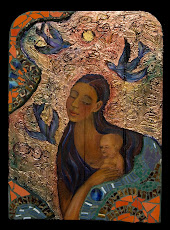
Ancient and contemporary wisdom intertwine in the magazine Pure Inspiration. Robert Becker, the Editor and Publisher of the magazine weaves reader's stories among a selection of articles that inform and inspire.
I wrote a piece for the current issue of Pure Inspiration. Here's how the website describes the piece:
"Cristina Acosta discusses her experience as a painter, pointing out that "art" is more than just a particular activity: "Time and maturity have revealed to me that all humans are artists, whatever our medium may be. Our canvas is time and our palettes of colors are the choices we make." She emphasizes that for her, art is more a process than an end to be attained: "I keep painting, each stroke of my brush a record of the present moment. When the painting is done, my involvement with that set of moments in time is over. The images are now for the viewers. They will discover their own meanings."
Read this article when you purchase a copy of Pure Inspiration.
Read more about my books and articles on my site. You'll find a list of home decor, personal essays and writing about art.
Wednesday, May 21, 2008
Read My New Article About Art & Inspiration
Friday, May 16, 2008
Ask Cristina: Cork Floor Stairs
Dear Cristina,
Hello, we are about to install Wicanders cork in our living room. I researched flooring off/on for 3 years and kept coming back to cork but was never happy with the urethane finish until I found Wicanders WRT finish.
Question, I noticed you have cork on your stairs. How long has it been installed? How is it holding up? How did the installer match up the noses on the tread to the cork tiles? I really want to expand cork up our stairs. My flooring contractor is willing to experiment, but if he could contact your flooring contractor and 'talk shop', it would be most helpful. Any information you're willing to share would be really helpful.
I live in Oak Ridge TN. Would love to 'swing by' and see your floors but it's a little far. :-)
Thank you, Lois
Dear Lois,
Wicanders Cork Oak with the WRT finish is holding up beautifully on our stairs. We had the Cork Oak put down throughout the entire house (except for Marmoleum in the bathrooms) about one-and-a-half years ago. The installer nailed the floating plank pieces directly to the riser and tread. An artisan woodworker, Terry Scoville made bull-nose trim pieces in white oak to match the trim in the rest of our 20 yea
r old home. Before the bull-nose trim pieces where nailed to the treads, I stained them with a watery artist acrylic I mixed (to mimic the existing stain) then coated them in Benjamin Moore's Benwood Stays Clear acrylic floor sealer (satin finish). We do wear our shoes in the house and our traffic patterns are tight. Nonetheless, the Wicander's Cork Oak has held up beautifully. I highly recommend the flooring.
Best Wishes with Your Project,
Cristina
Wednesday, May 14, 2008
Honoring Mother's Day - My Grandmother's Life as an Artist
Multi-Cultural Musical History in Southern California
In the early 1920's my grandmother Catalina Maria Ortiz Acosta and her family, living in Los Angeles, befriended Charles O. Roos and his wife, Jaunita E. Roos. The family connection was certainly enriched by Catalina's friendship and professional relationship with Jaunita. Catalina (1904-1991) was then a twenty year old classical pianist and the featured pianist at concerts the Roos organized. My grandmother spoke with admiration regarding Juanita's musical abilities. Charles, an Easterner, moved to Los Angeles and worked as a newspaper feature writer when not involved with his work as a lyricist. His wife Juanita was a gifted pianist. They collaborated to create a variety of piano compositions. Charles also wrote poems and lyrics for other composers' music. The concert program for the event at the Ramona Convent in Alhambra, California illustrates the typical concert Roos organized. Nordskog Records recorded the concert. Unfortunately, I don't have a copy of that recording or know of it's existence.
Sifting through my Grandmother's photo albums I found several photos of Charles and Juanita. The photos of the people in the Native American outfits are my grandmother Catalina, and Chief Yowlache, dressed in traditional Native American Indianclothing for publicity photos that Roos used in his concert promotions. Chief Yowlache was the "Indian baritone" for the program. Catalina accompanied him and also played solos.
During a time of escalating social injustice, Juanita and Charles Roos were creating musical compositions that celebrated different cultures. Though women had only just received the vote, and womens rights were often negated, Charles Roos publicly acknowledged his wife Juanita's contributions, including her name on compositions they collaborated on. The concert program at the Alhambra Convent School illustrates that the Roos were actively promoting the beauties of the Native American Indian and Hispanic culture to the elite of the dominant Anglo society. Understanding the political climate within which my grandmother was making her musical contributions to culture increases my
admiration for her artistry and strength. She steadfastly dedicated herself to excellence in her art form and understood the symbolic importance of her image as a intelligent and accomplished Hispanic woman when many minds were closed to the idea of such a person existing.
I searched the internet for more information about the Roos and found an interesting essay. I've included an excerpt with a link back to the original author. You'll recognize the name "Lieurance" in the Composer/Lyricist column of the concert program. I've also included some links to historical documents that record the political culture of the era. The following excerpt sheds light on Roos connection to like minded Anglo intellectuals during this time.
Excerpt of an essay by Linda Marsh Helfman,© 2007 (The Photos are mine) http://polleymusic.lincolnlibraries.org/History.htm
"His (Lieurance's) interest in tribal music began in 1902 with a visit to his brother who was an Indian Agent on the Crow Reservation in Montana. From that time he began a life-long fascination with the music and customs of the Native Americans. He visited over 30 reservations and amassed a collection of several thousand recordings and transcriptions as well as a large number of Indian flutes. He also invited Native Americans to his studio in Lincoln for some of the recording sessions. It was often difficult to coerce the Indians into performing for his recording machine, but his understanding and patience with tribal ways won them over. He had an enormous respect for the people and had learned a great deal from the Native American wives of two of his brothers. Much of his vast collection now resides in the Smithsonian Institution, the New Mexico Museum, and the Archive of Folk Culture at the Library of Congress.
Lieurance drew upon Native American melodies for many of his own compositions which he then clothed in what he called the "harmonizing which our ears demand'. His most famous piece is "By the Waters of Minnetonka". It was first published in 1913, and became the number one sheet music hit of its day, with many subsequent published arrangements. It was performed and recorded by some of the leading musicians of the era and enjoyed world-wide popularity.
In the early 1920s Charles O. Roos, a feature story writer for a Los Angeles newspaper, happened to read about Lieurance and his work with Native American music. In
his younger days Roos had been a woodsman and raftsman on the St. Croix River and had written poems based on his experiences with the local tribes there. He realized that Lieurance was the right person to set the poems to music. The two of them met and decided to travel together in the Chippewa forest country of northern Minnesota in order to gather additional material and inspire themselves further. Using thematic material from Chippewa homeland, rain dance, ceremonial, and mourning songs, Lieurance composed music for Roos' poems, and the result was the "Eight Songs From Green Timber" song cycle which appears in this collection." © 2007Linda Marsh Helfman
Photos: copyright 2008, Cristina Acosta. Photo of single woman, Catalina Ortiz Acosta in the 1920's. Photo of Charles O. Roos and his wife Juanita Roos (inscribed to my grandmother, Catalina Maria Ortiz Acosta). Photo of Charles O. Roos with a paddle.
Monday, May 12, 2008
May 2008 Newsletter: Creativity is Connection
(From my website monthly mailings: sign-up here.)
Dear Friends,
Connections between people are more obvious than ever before in history. Virtual-world relationships on sites like Facebook and LinkedIn are blurring the external boundaries between our work, social and family selves. The boundaries between the different worlds we pass through during the course of our day and the different personas we may inhabit are now permeable. How do we keep centered, balanced and creative when the world around us is increasingly changeable?
Keeping the connections between eyes, hands and heart open requires practice. Meditation is one of the tools I use to keep the connections open within myself, therefore staying centered. A form of meditation, sketching is a fabulous way to stay in the present moment as it requires all of my attention. As my mind travels, my pen follows. My sketchbook is one way I connect with myself and the world around me. Drawing keeps me on track, both in my creative work and in my life. There is no separation.
Accessing deeper meaning doesn't have to be something that happens only in specials places or at special times. It's available to us 24/7 in all of our choices. I recently wrote a blog entry titled Authentic Color Vs. Color Trends that explores using the process of choosing colors for your home as a self-development practice.
Because we are creators, being connected is crucial. The fossil fueled motor and this boon (along with other factors) has led to global climate change, possibly humankind's biggest global challenge. At this time in history it is especially important that each of us are aware of our part in creating our small piece of the world and how those pieces interconnect with others.
Cristina
Note: I drew these ink drawings during a belly dance event. These drawings of belly dancers are ball point pen on 3" x 5" paper. Completed in about 5 minutes or so (as long as the dance lasted), they are representations of my visceral response to the movements and beauties of the dance and dancers. Though this sketch was 5 minutes, I've been sketching for over 30 years. What you're seeing in each sketch is the refinement of my ability to create an image that relates my experience along with leaving open-to-view the paths my mind took during the drawing/meditation. See how my love of movement influences my paintings on my site at www.CristinaAcosta.com
Saturday, May 10, 2008
Can Color Change Your Mood?
Feel like no matter what goes on around you, you are in control? Well, you are and you aren't. The senses we rely on to understand the world around us aren't always accurate. Shapes and colors manipulate how you perceive the world around you -- along with texture, temperature, scent, sound and more.
Think about bright colors and food. Vitamin rich fruits and vegetables are mostly colorful. Fast food restaurants don't serve colorful fruits and vegetables, so instead they put strong colors in the decor of the restaurant, the pictures on the menu and the packaging. Candy is almost always manipulated to be artificially brightly colored to appeal to the human impulse to eat brightly colored healthy food.
As obvious as the manipulation of food colors are, colors in our homes and business offices manipulate where our attention goes as we move through the space and how we feel about the space. A red door on a brown house focuses our attention on the door. But don't feel that colors have one note, like the keys on a piano. Though many studies of colors have outcomes that insist yellow is happy or red is stimulating, those studies can only address that color in one environment. Colors interact with each other to create a melody line, just as the keys of the piano can combine to create a tune.
The bottom line is yes, color affects your mood. But don't get caught up in creating a rigid identity for every hue. The interaction of a color with others and the cultural viewpoint(s) of the people experiencing the colors is the ultimate arbitrator. Assigning one emotional response to a color is like insisting that each note of the musical scale has an immutable meaning. Like insisting that the note of middle C is always happy and F minor is always sad.
Pay attention to the interaction of colors and strive to be aware of the meanings you've assigned to colors and you will begin to use colors more creatively in all aspects of your life.
See my color consulting work for residences and public buildings on my website at www.CristinaAcosta.com
Friday, May 9, 2008
Recipe: Key Lime Squares

I love to cook for my family and friends! Initially I was inspired by my grandmother's artistry with a variety of ingredients and my mother's love of experimentation when she baked. As the oldest child of seven children, I did quite a bit of cooking for the family. Encouraged by my success (if my teenage brothers didn't eat it, the dogs would), I was continually trying new recipes. Now, I'm married to a lovely man who eats most anything I make, and encourages me to cook every day (Hmm... what's up with the everyday thing?). He loves food and has an adventurous palette. (And he often does the dishes!) With his encouragement I'm continually trying new things.
Key Lime Squares
Cristina Acosta ©2007, 2008
Put one bite of this sweet/tart desert in your mouth and you'll be able to see the long, flat horizon of blue-green ocean layered under the green topped islands of the Florida Keys. Not really. But it is a nice fantasy. Nonetheless, these easy-to-make squares will give you plenty of time to make plans for your next tropical vacation. The shortcake cookie base enriched with nuts supports the creamy tart filling. Dress these up with a lime twist and a pretty plate for a dinner party or take them as is to a picnic and eat them with your fingers. Aloha! And recorridos felices! (Happy Travels)
Note: Click here to purchase this painting from High Desert Gallery in Sisters, Oregon
Tools: Blender / Vitamix or Food Processor or by hand, oven
Baking Pan: 8” x 8” x 2”
Yield: 6 to 16 pieces, depending on size cut.
Time: Baking time, 30 minutes. Assembly time 15-20 minutes
Base and Topping
- 1/3 Cup real butter, chilled
- ½ finely chopped nuts or ground nut meal. (pecans, walnuts, hazelnuts or almonds)
- 1/3 C. dark brown sugar, packed
- 1 Cup white flour
Filling
- ½ cup 100% unsweetened key lime juice, OR organic 100% lime juice, not from concentrate.
- 1 can sweetened condensed milk
- 3 egg yolks
Directions
Preheat oven to 350 degrees
Butter sides and bottom of pan
1. Combine all dry ingredients
- With a blender, food processor or by hand, cut the butter into the dry mixture until the butter is in very small pieces and the mixture has a crumb like appearance.
- Reserve ½ cup of the mixture for topping.
- Firmly press the remaining mixture into the bottom of the pan.
- Bake at 350 degrees for 15 minutes
2. While the base is cooking, mix filling:
- Mix the filling ingredients into a blender on low until the mixture is silky and well blended. (Don’t let the mixture get foamy.)
- Pour it onto the cooked base.
- Sprinkle the topping evenly across the filling.
- Return the pan to the oven and bake for an additional 15 minutes.
Serve at room temperature or chilled. Cut into servings after it has cooled. Refrigerate for ease of cutting into small squares or to transport (makes the dessert firmer).
Vitamix is more than just a big blender. It's a powerful tool in the kitchen and a powerful tool for a healthy diet. Vitamix recipes and techniques enable you to eat up to 10 fruits and vegetables along with whole grains that are recommended by experts and you'll love the ease and simplicity of the Vitamix. |
Sunday, May 4, 2008
Sacred Spaces In the Garden

My garden offers shelter to quail, rabbits, skunks and deer that wander through our 1/2 acre of Manzanita, Bitterbrush and Ponderosa pine near the city of Bend, Oregon. I've put out mineral salt licks, bird feeders and water features to support the wildlife. As you can imagine, I don't have much in the way of animal proof flora. What one animal doesn't eat, another one does. Mint and Shasta daisies resurface annually as none of the animals like them (except us -- we get great tea from our mint). It's ok with me -- I love watching the animals at the feeders and feel connected to supporting their presence in the continually developed surrounding lands.
Decorating my garden with art that can make it through the Bend, Oregon winters is tough. Metal and concrete make it through the extreme weather, so I use them to adorn the garden. During my trip to Oaxaca last February I found a small store that sold recycled aluminum recast into garden pieces. Made in Northern Mexico, the large pieces are light enough (compared to cast iron) to make it back home in my suitcase. I bought this 20" high aluminum cast Guadalupe.
When I got home I primed the piece with spray paint, then painted it in oils. My friend, Terry Scoville, an artisan woodworker mounted it on vintage panels she shaped and cut. My husband just hung the Madonna on the side of the house near the entrance to my studio and I adorned it with a shed horn and seashells I found along with some clay pieces my daughter made. My painted cast metal Guadalupe is a Retablo, presented on the wood panel in the Hispanic tradition of sacred art known as a Santos. See other examples of my ex-voto and santos style retablos on my website.
Wednesday, April 30, 2008
Sketchbook: The Art of Belly Dancing

Keeping the connections between eyes, hands and heart open requires practice. My sketchbook is the tool I use to connect with myself and the world around me. A form of meditation, sketching is a fabulous way to stay in the present moment as it requires all of my attention. As my mind drifts, the pen drifts. Drawing keeps me on track. Both in my creative work and in my life -- there is no separation.
Don't get the idea that I'm some sort of tidy, perfect sketchbook/scrapbook type. While I admire those people who naturally organize their experiences into tidy books, I've never been one. I keep little 3" x 5" sketchbooks (or larger) in the car, my purse, by the phone and other places to record a moment when it hits me hard enough to move my pen. Pages may be weeks, months, even years apart in the same book.
I'm not a picky sketcher. Ink pens are my favorite because drawings made with them don't smear easily. And, I don't sketch to a "finish". My pieces are usually only a matter of minutes long. Fifteen minutes for a quick sketch is my usual limit, 1 to 5 minutes is more likely. That seems to be either the time I have or my attention span. Either way, the result is the same. Dance is a particularly favorite thing for me to draw. I love the fluid movements and focused energy. The challenge of drawing moving subjects entrances me.
Last week I attended the High Desert Belly Dance Guild's April Showcase in Bend, Oregon, an exhibition of a variety of dance styles from several of the Guild member teachers and students. Fascinated with dance, I started taking belly dance lessons last fall from my friend, Kathy Southwick, a life-long dancer. Her class is fun and her music mix always inspires an extra shimmy. Attending the dance class gives me insight into feeling my visual experiences kinesthetically. Sketching is a way to feed and educate my art from the inside, rather than always looking for external influences such as style, fashion or concepts about what defines good art.
Drawing Note: These drawings of belly dancers are ball point pen on 3" x 5" paper. Completed in about 5 minutes or so (as long as the dance lasted), they are representations of my visceral response to the movements and beauties of the dance and dancers. Though this sketch was 5 minutes, I've been sketching for over 30 years. What you're seeing in each sketch is the refinement of my ability to create an image that relates my experience along with leaving open to view the paths my mind took during the drawing/meditation. See how my love of movement influences my paintings on my site at www.CristinaAcosta.com
Remember, these images are copyright protected. Please do not copy them without my permission.
I Love Using My Vitamix!