Showing posts sorted by relevance for query reshaping the divine. Sort by date Show all posts

Wednesday, June 3, 2009

Reshaping the Divine - Contemporary Hispanic Retablos Exploring the Sacred Feminine


This exhibit is up for Summer 2009. The artist statement describes the personal context of my art and about the intent behind these pieces.
_______________________________________________________________
Reshaping the Divine: Contemporary Hispanic Retablos Exploring the Sacred Feminine

Cristina Ortiz Acosta – Artist Statement 2009 - Exhibit at El Museo Cultural, Santa Fe, New Mexico. Click here to see this series of Hispanic Retablos.

Over the past twenty years, my series of Madonna retablos came to me in ebbs and flows via a series of powerful dreams. The dreams started during my pregnancy with my daughter. For the entire pregnancy I dreamt of being a woman on a journey north across dusty plains and through arroyos as I mostly walked behind an oxcart. The dreams ended in a room lit by a wooden candelabra filled with tallow candles and the birth of my daughter, Isabella Pilar in 1993.

I called these dreams my Maria Dreams because in the dreams, I/she was named Maria. Seeking the meaning of those dreams over the years brought me down a path I could never have imagined and deepened my understanding of my cultural heritage. Searching for the meaning of my Maria Dreams eventually lead me back to New Mexico, the land of my Ortiz ancestors.

My paternal grandmother, Catalina Maria Ortiz Acosta, born in 1904, was the daughter of J. Nestor Ortiz and Maria Elena Salazar, descendents of the original Spanish settlers founding the cities and villages throughout New Mexico. Researching my family genealogy (my grandmother spoke vaguely about her ancestors), I discovered that my direct ancestors had participated in the initial 16th and 17th century migrations of the Spanish, traveling North from Mexico City into the region that is now the State of New Mexico. I read books about the era and became fascinated by the types of experiences my female ancestors must have had while living on the New Mexican frontier for generations. With this research nurturing my experience of my personal history, my calling to paint Madonna’s began to take shape.

Born in Los Angeles to an Anglo mother and Hispanic father, early on I was aware of cultural concepts because of the differences between the two sides of my family. Despite their differences, Catholicism was the central theme for my parents. Celebrating their devotion resulted in religious images from the Americas and Europe scattered throughout our home and those of our relatives. Images of Mary the Mother of God as the Guadalupe, Conquistadora and many other versions were always present. Along with those images were displayed American Indian items from the Ortiz ranch.

The artifacts from the Ortiz family ranch consumed my imagination from as far back as I can remember. Handmade Indian blankets and pots, and even a gold menorah (referred to as a “candelabra” by my grandmother) made by Ortiz ancestors generations past (some of the men were renowned filigree gold smiths). Those as well as the chili ristras hanging in my grandmother’s kitchen hinted at another world far from the Southern California beach scene of my childhood home. For reasons I can’t sufficiently articulate, the mix of these images and experiences coalesced into my calling to visually explore and create new images of the Madonna as an expression of the feminine divine.

Each of the retablos I paint results in a new vision of the sacred. For example, painting La Conquistadora opened the door to re-balancing the dominant patriarchal and European view of the divine with the North American native and feminine. In La Conquistadora I layer symbols of the Dine Spider woman and the Puebloan Corn Maiden, seeking to blend the indigenous ancient female images and concepts harmoniously with the Catholic image of Mary. The result is a Madonna that hints of ancient goddesses many thousands of years old at the same time she conveys the current blend of cultures in the Southwest.

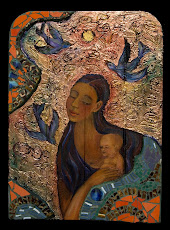
I create my work in the traditions of the Spanish/Mexican retablo to reinforce my expression of reverence and convey the intimate experience of sacredness. I find antique, reclaimed timbers for the substrate. I mix gold, silver and copper metals into my oil paintings to both embellish the image and in homage to the gifts my ancestors created for me with their existence. The vintage gold glazed ceramic tiles come from a tile company that operated near my childhood home in Southern California during the 1950’s and 60’s. When I finish a retablo, I write a blessing on the backside of the retablo to convey love to all who view the images.

My Maria Dreams from over a decade ago continue to influence this series of work. May you find your own meanings and blessings within these images.

www.CristinaAcosta.com

Monday, July 13, 2009

Latin American Herald Tribune Features My Exhibit - Reshaping the Divine

Thank you to the Latin American Herald Tribune, for the interview and feature of my art exhibit, Reshaping the Divine - Contemporary Hispanic Retablos Exploring the Divine Feminine, on exhibit at the El Museo Cultural in Santa Fe, New Mexico for the Summer 2009.

I am very appreciative that my work is getting such positive attention. I've included an excerpt. You can READ MORE here.

EFE News Services (US) Inc. www.efe.com
Spain's International News Agency- Agencia EFE is the leading newswire service in Latin America and Spain. Everyday, directly or indirectly, millions of individuals are brought up to date on what is happening in the world by EFE. Of its total 3.600 media subscribers, 531 are
located in South America, 110 in Mexico, 62 in the Caribbean, 78 in Central America, 150 in the USA and others in Spain, Europe, Africa, The Middle East and Asia.

____________________________________________________________
Chicana Artist Explores Heritage Through Retablo Paintings

By Lydia Gil

SANTA FE, New Mexico – Chicana artist Cristina Acosta has turned to sacred art as a means of exploring her religious and cultural heritage, incorporating aspects of her life, beliefs and family history into Madonna retablos.

“The tradition of the retablo (devotional image) reflects both the past and the present,” said the artist, whose works are now on display as part of an exhibit of contemporary retablos at this southwestern U.S. city’s El Museo Cultural.

The word “retablo” in Spanish dates back to the Renaissance and Baroque era and was used to refer to large screens that were placed behind altars in churches and were decorated with paintings, carvings, and sculptures.

These large altar screens then became prevalent in colonial Latin America as well, and by the 19th century oil-on-tin retablo paintings of Christ, the Virgin, and saints were commonly produced by amateur artists for devotional use in the home.

However, in parts of the southwestern United States, such as New Mexico and Colorado, retablos passed beyond the realm of sacred art into that of folklore.

Acosta said there are two types of retablos, one belonging to the tradition of Catholic saints and the other to that of “ex-votos,” or offerings of gratitude.

She says the first group is similar to the concept of icon painting in Byzantine art, in which the figures of saints or the Holy Family are painted in accordance with strict liturgical rules that define how the main figure should be portrayed.

“The counterpoint to that tradition is the ex-voto retablo, for which there are no rules but rather (the artist) creates a personal vision to give thanks for a blessing (received) or when a petition was heard,” she said.

It is within this folk tradition that her art is rooted.

Acosta said her retablos have served as a medium for meditating on her family heritage, her Latino identity and her role as a woman and an artist.

“My retablos are strictly related to my life, my Latina-Chicana cultural heritage in the southwestern U.S. and my personal opinions and life experiences,” she said.

Acosta, who now lives in Oregon, grew up in a Catholic family – the daughter of an Anglo-American mother and a Mexican-American father – in southern California. . . . READ MORE

Here are some links:
http://mx.news.yahoo.com/s/10072009/38/n-entertain-retablos-marianos-dominan-arte-chicana.html
or
http://www.impre.com/eldiariony/espectaculos/2009/7/11/retablos-dominan-el-arte-de-cr-134844-1.html

The article was picked up by the international service, so you may find it in Latin America and Spain as well.

Here it is in English translation:
http://www.laht.com/article.asp?ArticleId=338991&CategoryId=13003
__________________________________________________________________
www.CristinaAcosta.com

Tuesday, July 14, 2009

Muchas Gracias La Bloga for Your Review of Reshaping the Divine

Muchas Gracias to La Bloga for the generous and positive review of my art exhibit, Reshaping the Divine - Contemporary Hispanic Retablos Exploring the Divine Feminine currently at El Museo Cultural, Santa Fe, New Mexico. You can read the full piece and a lot of other very interesting things on La Bloga.


Here's an excerpt of the review:
__________________________________________________________________
"This is quintessentially female, strong, sinous, visual art. It is a contemporary re-visioning of traditional retablo, hinting at the aesthetic of popular commercial artists like Laurel Burch, but containing a depth of spirit. There is a certain richness, an evanescence emanating from the figures portrayed.

Acosta has an ability to make a heart connection with the observer beyond the demands and trends of the marketplace, or the prevailing winds of "fine" art communities and critics. I find Acosta's work to be completely accessible, capitalizing and re-visioning icons from a metizo heritage, as well as feminist ideas of the female God-force.


She's also creative in the use of precious and mundane material in the creation of these retablos. In an in depth look at her site, piece after piece reveals she is truly a renaissance woman balancing commerciality with content and succeeding admirably." READ MORE. . . .

www.CristinaAcosta.com
See the images of my retablos, santos and ex-votos.

Sunday, May 24, 2009

Exhibiting my Madonna series in Santa Fe

I'm in New Mexico this week delivering my paintings to El Museo Cultural in Santa Fe, NM. This series of contemporary paintings is from my Hispanic Heritage Series. My work is based on the traditional retablo form, but with contemporary imagery of Madonnas such as the Guadalupe, Conquistadora and others. What puts my images into the contemporary definition is that I "remake" the traditional iconic images rather than painting a verbatim image. 

The art exhibit  at El Museo Cultural is titled: Reshaping the Divine - Contemporary Hispanic Retablos Exploring the Sacred Feminine, by Cristina Ortiz Acosta.  I use a longer version of my name for my Hispanic Heritage Series in homage to my New Mexican ancestors. 

In New Mexico, my grandmother's family were referred to as "Spanish", a term that is still used today. In New Mexico, being a Mexican American or Chicano has a different meaning than in the rest of the United States because those terms do not specifically denote the Hispanic people that have been in this part of North America for over 4 centuries and still refer to themselves as Spanish. The variety of ways to describe oneself or others is  kind of confusing if you're not aware of the meanings.

The reason I'm bringing this up is to describe the cultural context my series of retablo paintings are part of -- the conceptual foundation is the New Mexican or Spanish retablo and ex-voto traditions of my Ortiz ancestors.

It's very satisfying to work with the Madonna theme -- I love the nuances of meaning I consider with my choices of imagery, shapes and color. 

This exhibit of my contemporary New Mexican Spanish retablos of madonnas is through Summer 2009 at El Museo Cultural, 615 #B Paseo de Peralta, Santa Fe, NM. 

Note: Image is titled  Running Meditation

Friday, September 11, 2009

Gracias to Latina Magazine for the Article!

Angie Romero, a writer for Latina magazine wrote this piece, Madonna Mia about my art exhibit, Reshaping the Divine. Thanks Angie for supporting my work. Here's an excerpt from Latina:

_________________________________________________

My older sister was named Maria Auxiliadora, after the Virgin Mary. Maria is a very predictable name for a Latina, but my mom named her that because she was in a near-fatal car accident when she was pregnant with her firstborn, so she promised la virgen that if she and her baby survived, she’d be forever grateful. To this day, she is a devout Catholic. Me, I’m more spiritual, but that’s another story for another day.

I recently received an email from an artist who did a whole collection of Madonnas (as in the mother of Christ, not the queen of pop). Cristina Acosta was born in L.A. to an Anglo American mom and Mexican American dad. Her paternal roots date back to New Mexico in the late 1500s. Growing up, she says she was always fascinated by that side of her family tree.

Her Madonnas (my favorite of which is “La Sirena Verde,” which Acosta painted for her sister to celebrate her recovery from cancer) are painted with oil, sterling silver, copper, gold metal leaf, and inlays of antique, gold-glazed ceramic tiles. They often delve past the dawn of Christianity and also represent the earth religions of the Native Americans. . . . READ MORE at Latina
____________________________________________________________
www.CristinaAcosta.com

Tuesday, July 21, 2009

Thanks to Chicano y Que

Thanks to ?Chicano y Que? blog for posting info about my art exhibit, Reshaping the Divine: Contemporary Hispanic Retablos Exploring the Divine Feminine, at El Museo Cultural in Santa Fe, New Mexico for Summer 2009.

(Can anybody give me a tip to make a Spanish question mark and accent marks in Blogger?).

Chicano Y Que? is a blog Jesus Garza writes that is devoted to information related to Chicano/Chicana culture. Jesus is also a wonderful art and commercial photographer. You can see his beautiful photography, some of which includes photos of Cesar Chavez on his website, Jesus Manuel Mena Garza Photography.
www.CristinaAcosta.com