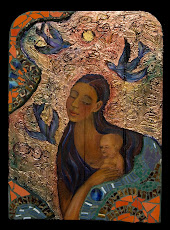
Showing posts with label art influences. Show all posts

Friday, October 23, 2009

Back to My Roots: Mexican-American Style Clay Ornaments

One of the strange things about life is that things from my earliest years of life come back into my life in different ways. This seems to happen more lately. Maybe it's an artistic cycle of some sort.

How it happens is interesting. I get "stuck" in one aspect of my artistic work, so I do something that is very easy for me. Which is why I buy 100 pounds of clay now and then so I can play with making terracotta tiles or tile-like ornaments.

I've been a little stuck lately so out came the clay. I ended up making clay crosses, clay Jewish stars, and clay birds. Just in time for holiday gifts. It's fun. Making decorative clay pieces like this reminds me of some of the Mexican-American or Chicano crafts I would see growing up in Southern California. It's comforting to me as well as somehow seems to open the gates of creative flow within me.

So if you're stuck in some aspect of art (or life) maybe this approach will work for you. Not that you have to make terracotta ornaments. Sometimes I'll make hand-patterned fabrics to wear as sarongs or paint ties for my husband. Whatever it is, it's something I can completely relax with. Opening the kiln is always fun. Kind of like baking bread, but with a more permanent result.

www.CristinaAcosta.com

Wednesday, October 21, 2009

Helvetica - How a Letterform Became Part of All of our Lives

The movie Helvetica is a documentary about a type-face. Before you yawn-off (or click-out), wait a minute. Helvetica is a good movie. Really. At least for anybody interested in any of the arts, design, architecture and fashion fields.

Back in the mists of time when signs were actually hand-painted, I used to paint Helvetica as a letterform (type-form) on advertising billboards. (I was a billboard painter.) Helvetica was always a bit awkward to paint as it's roots were not from the brush and chisel roots of all of western languages letterforms, but from the machine age.

For more of an explanation about the roots of letterforms you must see the movie. Besides setting up the history of typography well, Helvetica the film has interviews with a variety of graphic designers who have completely opposite or divergent opinions about design from each other along with examples of their work so the viewer can make their own judgments.

Listening to contradictory opinions and design theories warms my heart. Strange -- but it does. I love that artists and critics do have strong opinions. And that they change those opinions. Been there, done that, over it is a credo that sits side-by-side with the purity of obsession over one thing for the rest of one's life.

About a week after seeing the movie Helvetica I was working with a designer on a logo I recently did for our family business, www.StandUpPaddleFlatwater.com. She was going through her list of fonts when I saw a name that intrigued me. "Let me see the font Switzerland," I asked her, wondering if what I thought I might see would be something funny.

I did see something funny. Switzerland looked almost exactly liked Helvetica. I don't know the history behind the Switzerland font, but I get the joke. Helvetica is a German made (and owned) type font that was originally supposed to be named after Switzerland. They changed the spelling slightly for the times. It was a marketing ploy of some type (see the movie). In response, somebody made a competing type form they titled Switzerland. A subtle joke tucked into a list of fonts. That's the kind of meaning in an everyday object that keeps the art world inspiring.

www.CristinaAcosta.com

Monday, July 20, 2009

Painted Sarongs for Sailing


Color and light filled with air propelling me across the surface of a High Cascade's lake. WOW!

Flatwater stand up paddling on lakes usually involves wind of some sort if you're out past noon. My friend, Judy Shasek and I were playing around on Hosmer Lake, Oregon last week and came up with a lot of things to laugh about while we experimented with our SUP boards.

Memories of catching the wind on windsurfers inspired Judy and I to take advantage of a tail wind and try some sailing. Since I often travel with sarongs (as SPF, clothing, mosquito distractor, etc.) I was ready.

I whipped my sarong into the air with a gust and Judy and I made a jib sail between us. It worked so well that we returned the next day with two sarongs and caught downwind puffs singly wherever we could. We even convinced Judy's husband, Ed to give it a try.

I painted these sarongs on silk and cotton and was totally grooving on how they looked filled with air and lit through with sunlight. Silk was definitely the material that won the day as a sarong sail. Silk is strong, lightweight and catches the wind easily. It also looks good on.

Judy and I got so caught up in sarong sailing that we almost re-invented the windsurfer!

Judy's husband, Ed Shasek took the photos (unless he was in them).
www.StandUpPaddleFlatwater.com

www.CristinaAcosta.com

Saturday, July 18, 2009

The Barbra Streisand Rose

Portland, Oregon is an interesting city to visit. I'm often in Portland taking my daughter to her fencing training, so I'll take a few hours while she's training to be a tourist and check out the local scene.

The Portland Rose Garden is a beautiful garden on the side of a small mountain that overlooks the city of Portland and the river. I was there a few weeks ago around the Rose Festival dates and made sure to visit the rose garden. The scents and colors of hundreds of blooming rose bushes is worth a visit.

I asked a gardener to send me to the roses with his favorite scents and he sent me to the bottom of the garden looking for the Barbra Streisand Rose. Wandering the garden I came across this very handsome poodle and his two female owners. I asked them why he was dressed in a Hawaiian lei and decorated. They told me that he had just recently won First Place in the dog contest in the Gay Pride Parade downtown.

"Is he gay?" I asked, pointing to the dog.

"Of course, he is," they replied, "that's why he was in the parade."

I pointed out the Barbra Streisand rose, a deep pink rose with an extravagant scent and asked them if I could take the dog's photo in front of the rosebush.

"This is wonderful," one of the women said as she helped to pose her dog, "we just got him a Streisand CD yesterday."

www.CristinaAcosta.com

Friday, June 5, 2009

Nature Influences My Art

The well of experience that I draw from to create includes everything I experience. To keep the waters of creativity flowing, it's very important that I continue to experience new things and experiment with different viewpoints.

Changing my viewpoint is a lot easier when I try something new that always pushes me to learn. One of the easiest methods to bring fun and positive change into my life is athletics. Stand up paddle boarding has become one of my favorite sports. This is my third summer of paddle boarding and I'm hooked. I've learned to surf ocean waves, wind-driven lake waves, and paddled rivers. Besides being fun, stand up paddleboarding puts me in to intimate contact with nature. I'm often on waterways that have their own life rhythms and images.

Last weekend I went on a 35 mile downriver paddle with some of our local stand up paddling group. (You can read more about paddle boarding on the SUP Stand up Paddle blog my husband I and share.) The nine hours we were on the Deschutes River in Oregon, filled my senses with both obvious imagery and more subtle experiences.

I work animal and plant images into all of my paintings regardless of the style I'm working in. Here are a few examples of oil paintings I've done that focus on animals. The Blue Heron is a large 4' x 6' oil of an experience I had watching a Blue Heron fly through the forest before dawn. The Eagle is a raptor that I see often on the High Desert Plateau near my home. The Deer Herd is often in my garden (eating or drinking!). Flora, fauna, madonnas and figures populate my imagery and flow from my actual experiences. Figure drawing once a week keeps me in touch with on of my favorite artistic disciplines, stand up paddle boarding is another type of discipline. It's all good!

www.CristinaAcosta.com

Saturday, January 31, 2009

Don't Sell Your Inspiration Short

During the early years of my life as an artist, people would look at my work and often ask me, "How can you possibly part with (or sell) that painting?"

My desire to make a living from my art meant that I had to make peace with the reality that to make a living I have to sell my work. Seems like such a simple concept, but ironically many people think that creating art for money somehow sullies the purity of the art.

It is strange that art is afforded this expectation even though God/religion and money/power have been hand-in-hand for centuries. It's as though some people think that art work has no relation to real work. I know of many talented professionals in other fields who would never think of working for free or heavily discounted unless the work was pro-bono for a worthy cause. Yet, I know many artists, (including myself, before I got a clue) who will give discounts to wealthy people or corporations (who can certainly pay) for a variety of reasons that mostly boil down to low self esteem combined with a feeling of scarcity.

The fact is that in the world we live in, money is necessary to support anything. Here are a couple suggestions:
  • For Collectors - Before you ask an artist for a deep discount, be aware that a synonym for discount is disregard. When you ask a creator to discount deeply (they are not some big box retailer or corporate chain) consider the possibility that you are asking them to disregard the value of their work (sometimes to the degree that the artist will have to stop working or will have to stop innovating so as to create "saleable" pieces). Be sensitive.
  • For Artists - Remember that your work has value. Be aware of how your prices fit with comparable work and don't undersell or oversell yourself. It's easy to think that price alone matters. If you want to give away work, gift a non-profit agency, they are always looking for help.

Monday, December 15, 2008

Feast of the Guadalupe December 12th

Sometimes things happen that seem so mysteriously destined that I'm amazed at the richness of this universe. About 4 or 5 years ago a man called my business number and asked if I had any interior design need for furnishings. He was a semi-retired fine carpenter and furniture maker and was looking for new business contacts.

When he told me he was in Albany, Oregon a city in the Willamette Valley about 2 1/2 hours from my home in Bend, Oregon. I was curious as to why he would call someone out of his geographic area. When I asked him, he said that he had just started experimenting with calling people and that I was the first Hispanic name he saw under the Designer category in the phone book. As he was Chicano (Mexican-American) he said he hoped I would be nice because my name was Spanish. (My late father was Mexican-American or Chicano, hence my Spanish name.)

Once he told me he was practicing his business skills on me, we both relaxed and chatted a bit, talking about what it was like to be one of the very few Mexican-Americans (Chicanos) in Oregon during the 1980's. I told him about my series of retablo paintings of Madonnas that I was working on.

He then told me that he had something he needed to get rid of before he retired, and that I might be the perfect person for it. He said that he had a Catholic Church confessional from a church that had been closed. Though he was vague as to how he came by the piece, he'd had it for over 30 years and asked if I would like to buy it. Without photos I said no, though it sounded interesting. After our conversation I sent him a postcard of one of my retablos, La Conquistadora / the Corn Maiden / Dine Spider Woman.

The next month and for about 6 months afterward, the man would check in with me to see if I'd like to buy his confessional. I never saw a photo and always said no.

Then one Saturday morning he was parked at my studio in a work van with a friend. I was stunned that he had driven over 2 hours over a mountain pass and hadn't called to even see if I would be there. My husband, Randall had been at work (at that time our work spaces were in the same building) early to catch up on things and met the man when he knocked on my husband's door to ask if he knew where I was.

I drove up to the studio building to see Randall standing at the back of the man's open van and signaling me the absolutely-no-way hand signals in tandem with the what-in-the-heck-is-going-on eyebrow raise.

Stepping behind the van I looked in to see the "confessional" and was struck with amazement. The sections of cabinetry and plastic ziploc bag of "extra parts" looked like nothing but scraps of old wood and a lot of work to my husband, but I could see that what I was looking at was an altar.

That was it -- I really wanted that pile of cabinetry. The man and I went back and forth on a price and I bought the cabinet. Randall was totally against the idea, but as it wasn't a "affecting both of us for life" type of decision, I bought it anyway. Fortunately, Randall is a lovely guy who happens to be handsome, handy and dotes on me -- so, he put the cabinet together despite his initial dismay with my decision to buy the cabinet.

I was so filled with amazement at the synchronicity and magical quality of life. I cleaned the pieces of wood with Citrus thinner and Randall put the puzzle of pieces together until it was a complete shrine. I asked everyone I thought might know, if they knew anything about the cabinet. Nobody did, but I felt that it was a shrine for the Guadalupe. So, I had my artisan woodworker friend, Terry Scoville, make me 2 wood panels to fit the "holes" left in the cabinet after someone had removed something years ago.

I painted an image of the Guadalupe with Child in oils, 22kt. gold leaf, wax and antique ceramic mosaic to suit the intimate space of the shrine along with a thin horizontal insert. Randall installed them. It is beautiful and we get so much pleasure from viewing the shrine. The shrine to Our Lady of Guadalupe is my constant reminder of the strange and often ironic, abundant beauty of life.

A couple of years later, while traveling in Taxco, Mexico I saw identical woodwork on 2 confessional chairs in the Cathedral at the top of the hill and knew that the shrine had "found" me. The man from Albany, Oregon had indeed found the "right" home for what he thought was a confessional, but in reality was a Shrine to the Guadalupe.

In Mexico, the top part of the cabinet (with the portrait of the Guadalupe) is removed from the stand (or bottom section) and is carried at the head of a procession on Dec. 12th. Sometimes the curtain is across her image during part of the procession, other times not -- it depends upon the local traditions. During the rest of the year, the top part sits on the cabinet in a church.

I often light candles I put in the cabinet, or just turn on a light to enjoy it. My friend, Mimi Graves brought me a ristra of local grown red chilies which dried while hanging from the cabinet door. Here's some info about the festival.

Catholic traditions include Feast Days which are specially designated days for a Saint or Holy Person. December 12th is the Feast of Our Lady of Guadalupe. In Mexico, this feast is one of the holiest days of the year. Though the concept is not sanctioned by the Catholic Church, some people consider the Guadalupe to be the Christian version of the Aztec Mother Earth goddess Tonantzin. The Our Lady of Guadalupe festival is much more of a tradition in Mexico than in the U.S., though in areas with a lot of Hispanics there are often processions to celebrate the day. Images of Our Lady of Guadalupe are often considered Chicano art, Catholic religious art or Hispanic art -- To hispanics of Mexican-American ancestory, the image of the Guadalupe is a symbol that goes beyond religious affiliations to become an icon of identity.

I was raised very Catholic and consider myself a Chicana or Latina. Despite the spiritually seismic shifts I've experienced that re-shaped my beliefs, I love to paint Madonnas and think of them as expressions of the Divine Feminine. You can see more of my Madonnas here.

Tuesday, December 9, 2008

Re-Writing History

I've been going through my late paternal grandmother's (Abuelita's) photos and putting together an essay that includes a piece of her story as a classical pianist in Los Angeles, California during the 1920's. Though now my grandmother might call herself a Chicana or a Latina, during her generation, Hispanic Americans that were not directly from Mexico, but had a history (often for hundreds of years) in the Southwest called themselves Spanish or (if they lived in California) a Californio (male) or California (female).

So I grew up referring to her as my "Spanish Grandmother" when I didn't call her Abuelita (the Spanish word for grandmother). Her name was Catalina Maria Ortiz Acosta and she was a renaissance women who was very cultured and talented. I put together an essay on my site describing her contribution to the classical music scene in Southern California circa the 1920's. I also submitted it to LatinoLA and they published it also.

Here's the beginning of the article and a photo of my grandmother: The article is titled, "My Abuelita was One Talented Mujer (Woman)

Multi-Cultural Chicano Musical History in Southern California with Classical Music Indianist Composer and Chicana Pianists in LA

Ances_Cat_inFur_1924_web.jpg Los Angeles during the early 1900's was not a friendly place for Mexican-Americans and Chicanos. Though originally part of Mexico, California was annexed by Anglos to become part of the United States of America in 1848. With the gold rush of 1842 and other immigration, the existing American Indian and Spanish / Mexican people of California were politically and socially marginalized. By the 1920's lynchings, racially motivated attacks and "anti-greaser" laws were in place to control and dominate the Mexican American (Chicano) population of California. Pressure on Mexican Americans increased and included segregated schools in areas of Southern California where large groups of Chicanos persisted. The famous case, Mendez vs. the Board of Education finally ended Hispanic segregation in the late 1950's.

Intelligent, cultured and talented Hispanic Americans were not lauded. In fact, with the veil of racism over many Anglo peoples perceptions during that era, there was very limited press coverage of the positive cultural contributions of Chicanos in Los Angeles. History is written by the "winners", and as a conquered population, Spanish / Mexican Californians have lost many of their historical cultural contributions to a lack of attention.

As a third generation Californian (I now live in Oregon), I found some Chicana history within my family that pertains to the larger political climate and the cultural life of elite Angelinos during the early part of the twentieth century. In the early 1920's my grandmother Catalina Maria Ortiz Acosta and her family, lived in Los Angeles. The last of eighteen children, my grandmother Catalina was the daughter of J. Nestor Ortiz and Maria Salazar Ortiz. J. Nestor was a wealthy man who had owned several businesses and a sheep ranch in the town of Ortiz, Colorado (near Antonito, on the border with New Mexico). J. Nestor sold his interests in Colorado and re-located in Los Angeles, California in 1903. Catalina was born the next year. Though her ancestors where among the founding families of Santa Fe, New Mexico (and other towns in the region), she would often refer to herself and family members as "Californios" or "Spanish". Either were terms that people (Anglo and Hispanic) in her generation used to refer to the Spanish families that lived in the American Southwest when that region was under the control of Spain/Mexico. Because she was born in California, the term "Californio(a)" is accurate, but not completely reflective of her cultural heritage. The term she used usually depended upon her sense of the listener's knowledge of these finer points of cultural history.


Though the term Californio/a is dated and not used today, it was very meaningful for Spanish citizens of California who became citizens of the United States because of the Mexican War in 1848. My grandmother would often express her Ances_Chief-Yowlache-web.jpg indignation towards prejudice that any family member encountered with the comment, "Those peasants don't realize that we are Californios." I smile when I think about that. She disdained the prejudice that she deemed more a result of a lack of a good education than a lack of kindness. (I'm including this information about her cultural ethnic appellation because you will note that the concert program below refers to her as a "Spanish-American Pisaniste".)

The Ortiz family befriended Charles O. Roos and his wife, Jaunita E. Roos. The family connection was certainly enriched by Catalina's friendship and professional relationship with Jaunita. Catalina (1904-1991) was then a twenty year old classical pianist and the featured pianist at concerts the Roos organized. My grandmother spoke with admiration regarding Juanita's musical abilities. Charles, an Easterner, moved to Los Angeles and worked as a newspaper feature writer when not involved with his work as a lyricist. His wife Juanita was a gifted pianist. They collaborated to create a variety of piano compositions. Charles also wrote poems and lyrics for other composers' music. The concert program for the event at the Ramona Convent in Alhambra, California illustrates the typical concert Roos organized. Nordskog Records recorded the concert. Unfortunately, I don't have a copy of that recording or know of it's existence.

Sifting through my Grandmother's photo albums I found several photos of Charles and Juanita. The photos of the people in the Native American outfits are my grandmother Catalina, and Chief Yowlache, dressed in traditional Native American clothing for publicity photos that Roos used in his concert promotions. Chief Yowlache was the "Indian baritone" for the program. Catalina accompanied him and also played solos.

During a time of escalating social injustice. . . READ MORE.

NOTE: All photos copyright Cristina Acosta.

Friday, June 27, 2008

Journaling and Art

Journaling seems to be as popular as ever -- maybe even more so since it's one of the few reasons left for a person to write something by hand. For several years I journaled almost daily, inspired by Julia Cameron's advice to write "morning pages", a process she details in her book, The Artist's Way. I never read my journal entries. Just stacked college ruled notebooks filled with entries in a pile. I stopped journaling when the pile reached 30".

After that phase, I had a stint making "morning drawings". Eventually, I took up running and gave up journaling altogether. Something shifts -- I become completely saturated in an activity (sometimes for years) and then I suddenly stop doing whatever it is I was dedicated to and move to the next interest.

I'm thinking of revisiting my interest in journaling. I had to quit Nordic and Alpine skiing and running this past winter and spring after I sprained my knee on the way into the lift line after a morning of epic powder on the backside of Mt. Bachelor. Thanks to the highly skilled sports medicine/massage/therapists in our town of Bend, Oregon, I'm back on my exercise track.

During my hiatus from my usual activity I had more time to read. I revisited some of the books I read during college. Daybook - The Journal of an Artist by Anne Truitt was a book I scanned quickly and check off the book list my painting professor gave me in the 1980's. Revisiting the book was a real pleasure. Passages Anne Truitt wrote have new shades of meaning to me now that I have 20 years of art experience behind me.

Here's what Truitt had to say about creating. She wrote this in the early 1970's long before computers dominated our culture. Long before the rise of emailing and texting have almost completely eliminated the hand written letter:

"Like earthworms, whose lives are spent making more earth, we human beings also spend ourselves into the physical. A few of us leave behind objects judged, at least temporarily, worthy of preservation by the culture into which we were born. The process is, however, the same for us all. Ordered into the physical, in time we leave the physical and leave behind us what we have made in the physical."

Whether I'm drawing or writing, watching the marks as my hands guide the pen across the page, I see my thoughts made physical in a way they aren't when I'm at my keyboard. Maybe the general fascination with journaling has a little to do with this creation of a physical mark. Like our ancestors leaving marks with charcoal sticks on the sides of rock caves, we have left something material to mark our passing.

I really should re-read those old journals and see if they are going to be next winter's fire starter.

Wednesday, June 18, 2008

Doing it All - As Good as it Gets

How do I have a life and continue being an artist? Or is the question -- How do I remain an artist and still have a life? The question I ask myself depends upon which part of my life is getting most of my attention. Like most professional women with a family, I'm always balancing my activities as a mother, wife, daughter, sister and friend along with working and making art ("work" means running a household, paying bills, marketing my art work, etc.)

So, how do I do it all? If I measure my actions or progress by the day, I often feel like I've grasped the tail of life as it whips past me in a strong wind and I'm barely hanging on for the ride. Along with that feeling sometimes comes the sense that I'm not doing anything at my best. At those times I have this fantasy vision where all of the non-creative yet essential stuff in life is done for me and I "just" make art. In the midst of that fantasy I'm serene and focused and everything I do turns out well because I have the time to make it marvelous.

But my life doesn't work that way. And neither does my art, at least not now. Whatever the creative work I'm engaged in, speed and multiplicity are the order of the day. There is little time to mull over every thought. I don't have time to change much. Whatever I'm doing now is my "best." Whatever just happened is as good as it gets. Vision has been outpaced by reality, again.

That concept is an interesting and challenging idea to make peace with. Art like life is what it is. The meaning assigned to art (and life) is what changes. And with that in mind, let's make the best of it!
www.CristinaAcosta.com

Tuesday, June 17, 2008

Orphan Works Legislation Update June 17, 2008

You don't have to be an artist. If you've ever picked up a camera and taken a photo, the Orphan Works Bill, if passed will strip you of your copyrights, a right EVERY CITIZEN in the U.S.A. has when they have finished taking a photo, creating a film or painting a picture.
I've written about his before. Here's an update from:
___________________________________________________________________
FROM THE ILLUSTRATORS’ PARTNERSHIP
A Million People Against the Orphan Works Bill
http://www.petitiononline.com/Stop2913/petition.html

We support this petition. We urge you to sign it. Please forward the link and urge others to sign. You can help increase the power of the petition by signing your real name and listing your artistic specialties. If you are not a US citizen, we suggest that you note your country, and state if it is a member of the Berne Convention.

This petition is sponsored by A Million People Against the Orphan Works Bill, a new grassroots group founded by multimedia journalist Steve Lehman on Facebook and Flickr. All people are welcome to participate; it is not exclusive to these websites.

In 1987, Lehman broke the story of Tibetan unrest, later profiled in his award winning book "The Tibetans Struggle to Survive." As a visual artist intimately acquainted with the power of free speech, the protection afforded by the right to privacy, and the critical need for independent voices, Lehman, like the rest of us, is deeply troubled by any national policy that affects artists' control over their works.

Please forward this message to every person you know.

For additional information about Orphan Works developments, go to the IPA Orphan Works Resource Page for Artists at: http://www.illustratorspartnership.org/01_topics/article.php?searchterm=00185
_______________________________________________________________
FROM THE ILLUSTRATORS’ PARTNERSHIP -- An Orphan Works Solution

We have a proposal to solve the Orphan Works issue. It would let libraries and archives digitize their collections and let individuals duplicate family photos without fear of massive infringement penalties. These are the two needs most commonly cited by the bills’ sponsors and they can be resolved quite simply. Our proposal would limit the bill’s effects to works that are really orphans, with no unnecessary spillover effect to damage the commercial activities of working copyright holders.

Digitizing the Collections of Libraries and Museums
Digitizing someone’s work is an act of reproduction and is therefore subject to the authorization of the copyright holder. But to let accredited libraries and archives bypass these authorizations, the law could grant them certain exceptions to reproduce works without the prior consent of the rights holders, mainly for preservation purposes.

To avail themselves of this privilege, institutions could file a notice of intent to infringe with the Copyright Office, documenting that they’ve made a reasonably diligent, but unsuccessful effort to find the copyright holder. These exceptions should not be extended to cover reproductions on a mass scale, because that would clearly conflict with the artists’ own exploitation of their works and that would prejudice the legitimate interests of the copyright holders, a clear violation of the 1976 Copyright Act, the Berne Convention and Article 13 of the TRIPS agreement, to which the US is a signatory.

This proposal is consistent with the submission of the International Federation of Reproduction Rights Organizations (IFRRO) to the European Union’s i2010 Digital Libraries project. See our 2006 report on this: http://www.illustratorspartnership.org/01_topics/article.php?searchterm=00195
This means our proposal would meet the needs of libraries, museums and archives, harmonize US policy with our trading partners overseas and win wide praise from the creative community in the US, who would not see the rights of their own work put at risk.

Solving the Grandma issue
We believe similar orphan works situations - family photo restoration and duplication, personal genealogy usage of orphan works, and orphan works rights clearance for documentary filmmakers – can all be resolved in a similar manner, by carefully and precisely expanding Fair Use to permit limited individual infringements under contractual agreements.

For example, family photo issues could be resolved by means of a simple contract: the person who wishes to duplicate or restore a photo of Grandma could sign an easy-to-understand agreement (with either companies such as Wal-Mart or with the photographer next door), stipulating that they've made a reasonably diligent, but unsuccessful search to identify or locate the photographer of record. By doing so, they’d qualify for a precise limited copyright exemption to restore or duplicate the work for home and/or family use only. Under this scenario, it the photographer of record subsequently shows up, the contract would define the specific remedies.

The case of an individual who wishes to duplicate his or her own family photos would be even simpler to deal with: the individual would simply sign a form stipulating that he/she is the author and copyright holder of the photo - period. Any bad-faith assertions or violations of such agreements could then be dealt with as a contractual matter between individual parties, with no unnecessary damage to the rights of others.

A Limited, Workable Solution
We believe this kind of contractual solution to individual orphan works problems would have two virtues:

1. It would create certainty by specifying the terms of each transaction and would, in fact, mirror the kind of indemnification that professional artists and photographers routinely supply to clients, stipulating that our work is original and doesn't infringe the rights of others.
2. It would have the additional virtue of requiring that only those who avail themselves of the right to infringe would be required to understand the complexities of copyright law, unlike the present bill, which would require all citizens to familiarize themselves with the risks and obligations inherent in the proposed Orphan Works Acts.
3. It would not legalize the infringement of billions of managed copyrights on the grounds that some of them might be orphans.

We believe solutions like this could be arrived at amicably by working with members of the creative community, who are familiar with how copyright law intersects with standard business practice. This kind of imaginative solution should win widespread praise from all parties, while preserving the sanctity of existing copyright-related contracts. It would protect the small businesses that are the heart and soul of the creative community and would continue to act as an on-going incentive to further the creation of new work.

—Brad Holland and Cynthia Turner, for the Board of the Illustrators’ Partnership

Tuesday, June 10, 2008

When a Wild Beast is Just a Chicken

How you perceive what your see is colored by who you are. Your experiences, the time and place you live in, these things are inescapable. Everything is subjective. Not only is this true in life, there really is no such thing as objective art and design. Whatever is in the well of our thoughts and experiences spills onto our perceptions of images and design.

With that in mind I want to share with you a painting that I created from my fearful perception of an incident many years ago. I originally wrote about this in my book, Paint Happy.

This painting was inspired by the memory of my first night alone in an old ranch house in Central Oregon. During the dark early morning hours I heard loud mysterious animal noises inside the house. I imagined wild raccoons or bobcats prowling my room. There were no lights, and I'd left my flashlight on a table too far from the bed, so I decided to keep my head under the covers and wait until the animals left. Once the early morning sun began to light the room, I peeked out from under the blankets and saw a clucking chicken standing on the foot of my bed! A tall rooster with a colorful tail was perched on the dining room chair by the picture window and about six chickens were scratching the wooden floor and kitchen countertops. I didn't even know there were chickens on the ranch property. Apparently, there was a hole in the outside wall under the kitchen sink, and the chickens came in looking for breakfast!

More than a decade later, I took the best part of that memory - the comical surprise ending to my dark fear fantasies - and turned it into this painting. The rooster is crowing a rainbow of sounds toward the rising sun. The bed (symbolizing one's life) is the center of this universe and the land over which the sun rises and the clouds billow. This image captures the happy lesson that fear and worry are often a waste of energy.

This framed painting is for sale through High Desert Gallery in Sisters, Oregon.
Rise and Shine, 22" x 30" acrylic and hard pastel on paper.

Tuesday, June 3, 2008

Art and Fear

Most non-artists don't usually couple art and fear when they look at a piece of art. For most any artist who has been working for an extended period of time, art and fear are if not companions, at least at the same party.

Before I began teaching, I often thought that I was a minority when I noticed fear creeping into my art process. I noticed that the same litany of thoughts would drift occasionally across my mind when I was working: What will ____ think about this? Am I --- Open? Closed? Trite? Cute? Dumb? Boring? Good enough? (And more!) Will people think __ (something negative)___ when they see this image? Will anybody ever buy anything? Etcetera.

When I started teaching art in the early 1990's at Central Oregon Community College (a 5 year stint), I noticed that fear was often the biggest hurdle students faced. Talent, though a lovely and inspiring thing to behold was not what propelled artists to progress into mature work. It was their ability to confront and overcome their fears. I'm not talking about things like fear of heights or bugs or something like that, though that can be a starting point. I'm talking about the deep primeval fear of being excluded from the tribe - cast out to fend for oneself in a world full of long, sharp teeth, starvation and separation. That fear surfaces as negative self-talk, despair and artist block.

Most artists, except the lucky few (I don't know any, I fantasize they exist) at some point work in obscurity. There may or may not be local, regional or national success for the artist. Or, if that happens, the inevitable ebbs and flows of time and place, taste and fashion may again press the artist into isolation.

I've been working as an artist for over 2 decades, long enough to have experienced highs and lows. Neither conditions lasts, though that isn't comforting news from either perspective. Though I've taken more rides than I needed to, I've learned that rather than throwing my emotional self reactively on the roller coaster of "Yes, they LOVE it! / No, they hate it!" I had to train myself to put aside my fears and work anyway.

I hope I didn't make that sound easy. It wasn't. Here are 3 things that have worked for me:
  • Read about other artists: Their essays, biographies and autobiographies
  • Develop and maintain a meditation practice -- moving, sitting, drawing -- whatever works.
  • Work regularly regardless about how you emotionally feel about the work.
With this in mind I have two things to recommend: A book and a meditation system.

Art & Fear, Observations on the Perils (and Rewards ) of Artmaking, by David Bayles & Ted Orland, ©1998, 2001
This is a rich, concise, wu-wu-free book about what messes with your head -- or helps you -- as you negotiate the paths of your artistic/creative life.

Silva Life System, a meditation program originally developed by the late Jose Silva. I stumbled onto this system via some postal junk mail in the late 1980's. I found a set of his audio recordings at the local library, then in the 1990's bought my own set as a refresher. I've tried a lot of different types of meditation (I'm open to new things), but I return to the Silva Method. The Silva Method of Meditation offers the most practical tools for stress relief and visualization to some metaphysical techniques that enable a person to plumb the depths of their spirit.

Silva Life System

Wednesday, May 28, 2008

Do You LOVE Color? Visit this website

Webby Awards nominated the COLOURlovers website for their prestigious Best Community Website of the Year award for the second year in a row. If you think about color, you're going to love this website. Register and you can post your own colors.

I haven't begun to do more than lurk on the COLOURlovers site and read the great blogs and other entries. I'll let you know when I do more. In my spare time I've been putting together a PDF Color Consulting brochure booklet to explain my color consulting process to people interested in hiring me to do either on-site or remote (via email and phone), color consulting appointments. Until that's done you can see my color consulting portfolio on my website.

When that's done, I have some ideas for paintings I need to winnow down into a solid concept. Creating a painting is always an interesting process. I start dreaming about the pieces, then the images become so forceful that I paint them. This isn't true for all images. Mostly it's the case when I've been doing a lot of non-visual creative work (like writing) and my brain needs a long dose of non-verbal time.

Wednesday, May 21, 2008

Read My New Article About Art & Inspiration


Ancient and contemporary wisdom intertwine in the magazine Pure Inspiration. Robert Becker, the Editor and Publisher of the magazine weaves reader's stories among a selection of articles that inform and inspire.

I wrote a piece for the current issue of Pure Inspiration. Here's how the website describes the piece:
"Cristina Acosta discusses her experience as a painter, pointing out that "art" is more than just a particular activity: "Time and maturity have revealed to me that all humans are artists, whatever our medium may be. Our canvas is time and our palettes of colors are the choices we make." She emphasizes that for her, art is more a process than an end to be attained: "I keep painting, each stroke of my brush a record of the present moment. When the painting is done, my involvement with that set of moments in time is over. The images are now for the viewers. They will discover their own meanings."

Read this article when you purchase a copy of Pure Inspiration.
Read more about my books and articles on my site. You'll find a list of home decor, personal essays and writing about art.

Wednesday, May 14, 2008

Honoring Mother's Day - My Grandmother's Life as an Artist

Ances_Cat_inFur_1924_web.jpgMulti-Cultural Musical History in Southern California

In the early 1920's my grandmother Catalina Maria Ortiz Acosta and her family, living in Los Angeles, befriended Charles O. Roos and his wife, Jaunita E. Roos. The family connection was certainly enriched by Catalina's friendship and professional relationship with Jaunita. Catalina (1904-1991) was then a twenty year old classical pianist and the featured pianist at concerts the Roos organized. My grandmother spoke with admiration regarding Juanita's musical abilities. Charles, an Easterner, moved to Los Angeles and worked as a newspaper feature writer when not involved with his work as a lyricist. His wife Juanita was a gifted pianist. They collaborated to create a variety of piano compositions. Charles also wrote poems and lyrics for other composers' music. The concert program for the event at the Ramona Convent in Alhambra, California illustrates the typical concert Roos organized. Nordskog Records recorded the concert. Unfortunately, I don't have a copy of that recording or know of it's existence.

Sifting through my Grandmother's photo albums I found several photos of Charles and Juanita. The photos of the people in the Native American outfits are my grandmother Catalina, and Chief Yowlache, dressed in traditional Native American Indianclothing for publicity photos that Roos used in his concert promotions. Chief Yowlache was the "Indian baritone" for the program. Catalina accompanied him and also played solos.

During a time of escalating social injustice, Juanita and Charles Roos were creating musical compositions that celebrated different cultures. Though women had only just received the vote, and womens rights were often negated, Charles Roos publicly acknowledged his wife Juanita's contributions, including her name on compositions they collaborated on. The concert program at the Alhambra Convent School illustrates that the Roos were actively promoting the beauties of the Native American Indian and Hispanic culture to the elite of the dominant Anglo society. Understanding the political climate within which my grandmother was making her musical contributions to culture increases my Ances_Roos_Chs_Juanita_1924.jpgadmiration for her artistry and strength. She steadfastly dedicated herself to excellence in her art form and understood the symbolic importance of her image as a intelligent and accomplished Hispanic woman when many minds were closed to the idea of such a person existing.

I searched the internet for more information about the Roos and found an interesting essay. I've included an excerpt with a link back to the original author. You'll recognize the name "Lieurance" in the Composer/Lyricist column of the concert program. I've also included some links to historical documents that record the political culture of the era. The following excerpt sheds light on Roos connection to like minded Anglo intellectuals during this time.

Ances_PianoConcerT_1924_web.jpg Excerpt of an essay by Linda Marsh Helfman,© 2007 (The Photos are mine) http://polleymusic.lincolnlibraries.org/History.htm

"His (Lieurance's) interest in tribal music began in 1902 with a visit to his brother who was an Indian Agent on the Crow Reservation in Montana. From that time he began a life-long fascination with the music and customs of the Native Americans. He visited over 30 reservations and amassed a collection of several thousand recordings and transcriptions as well as a large number of Indian flutes. He also invited Native Americans to his studio in Lincoln for some of the recording sessions. It was often difficult to coerce the Indians into performing for his recording machine, but his understanding and patience with tribal ways won them over. He had an enormous respect for the people and had learned a great deal from the Native American wives of two of his brothers. Much of his vast collection now resides in the Smithsonian Institution, the New Mexico Museum, and the Archive of Folk Culture at the Library of Congress.

Lieurance drew upon Native American melodies for many of his own compositions which he then clothed in what he called the "harmonizing which our ears demand'. His most famous piece is "By the Waters of Minnetonka". It was first published in 1913, and became the number one sheet music hit of its day, with many subsequent published arrangements. It was performed and recorded by some of the leading musicians of the era and enjoyed world-wide popularity.

In the early 1920s Charles O. Roos, a feature story writer for a Los Angeles newspaper, happened to read about Lieurance and his work with Native American music. In Ances_Roos_Paddle_web.jpg his younger days Roos had been a woodsman and raftsman on the St. Croix River and had written poems based on his experiences with the local tribes there. He realized that Lieurance was the right person to set the poems to music. The two of them met and decided to travel together in the Chippewa forest country of northern Minnesota in order to gather additional material and inspire themselves further. Using thematic material from Chippewa homeland, rain dance, ceremonial, and mourning songs, Lieurance composed music for Roos' poems, and the result was the "Eight Songs From Green Timber" song cycle which appears in this collection." © 2007Linda Marsh Helfman

Photos: copyright 2008, Cristina Acosta. Photo of single woman, Catalina Ortiz Acosta in the 1920's. Photo of Charles O. Roos and his wife Juanita Roos (inscribed to my grandmother, Catalina Maria Ortiz Acosta). Photo of Charles O. Roos with a paddle.

Read More on my Website

Monday, May 12, 2008

May 2008 Newsletter: Creativity is Connection

(From my website monthly mailings: sign-up here.)

Dear Friends,

Connections between people are more obvious than ever before in history. Virtual-world relationships on sites like Facebook and LinkedIn are blurring the external boundaries between our work, social and family selves. The boundaries between the different worlds we pass through during the course of our day and the different personas we may inhabit are now permeable. How do we keep centered, balanced and creative when the world around us is increasingly changeable?

Keeping the connections between eyes, hands and heart open requires practice. Meditation is one of the tools I use to keep the connections open within myself, therefore staying centered. A form of meditation, sketching is a fabulous way to stay in the present moment as it requires all of my attention. As my mind travels, my pen follows. My sketchbook is one way I connect with myself and the world around me. Drawing keeps me on track, both in my creative work and in my life. There is no separation.

DW_BellyDance_I.jpgAccessing deeper meaning doesn't have to be something that happens only in specials places or at special times. It's available to us 24/7 in all of our choices. I recently wrote a blog entry titled Authentic Color Vs. Color Trends that explores using the process of choosing colors for your home as a self-development practice.

Because we are creators, being connected is crucial. The fossil fueled motor and this boon (along with other factors) has led to global climate change, possibly humankind's biggest global challenge. At this time in history it is especially important that each of us are aware of our part in creating our small piece of the world and how those pieces interconnect with others.

Live Happy,
Cristina

Note: I drew these ink drawings during a belly dance event. These drawings of belly dancers are ball point pen on 3" x 5" paper. Completed in about 5 minutes or so (as long as the dance lasted), they are representations of my visceral response to the movements and beauties of the dance and dancers. Though this sketch was 5 minutes, I've been sketching for over 30 years. What you're seeing in each sketch is the refinement of my ability to create an image that relates my experience along with leaving open-to-view the paths my mind took during the drawing/meditation. See how my love of movement influences my paintings on my site at www.CristinaAcosta.com

Friday, May 9, 2008

Recipe: Key Lime Custard Squares


I love to cook for my family and friends! Initially I was inspired by my grandmother's artistry with a variety of ingredients and my mother's love of experimentation when she baked. As the oldest child of seven children, I did quite a bit of cooking for the family. Encouraged by my success (if my teenage brothers didn't eat it, the dogs would), I was continually trying new recipes. Now, I'm married to a lovely man who eats most anything I make, and encourages me to cook every day (Hmm... what's up with the everyday thing?). He loves food and has an adventurous palette. (And he often does the dishes!) With his encouragement I'm continually trying new things.


Key Lime Squares
Cristina Acosta ©2007, 2008

Put one bite of this sweet/tart desert in your mouth and you'll be able to see the long, flat horizon of blue-green ocean layered under the green topped islands of the Florida Keys. Not really. But it is a nice fantasy. Nonetheless, these easy-to-make squares will give you plenty of time to make plans for your next tropical vacation. The shortcake cookie base enriched with nuts supports the creamy tart key lime custard filling. Dress these up with a lime twist and a pretty plate for a dinner party or take them as is to a picnic and eat them with your fingers. Aloha! And recorridos felices! (Happy Travels)

Note: Click here to purchase this painting , The Pastry Chef, from the High Desert Gallery in Sisters, Oregon

Tools: Blender / Vitamix or Food Processor or by hand, oven

Baking Pan: 8” x 8” x 2”
Yield: 6 to 16 pieces, depending on size cut.

Time: Baking time, 30 minutes. Assembly time 15-20 minutes

Base and Topping

  • 1/3 Cup real butter, chilled
  • ½ finely chopped nuts or ground nut meal. (pecans, walnuts, hazelnuts or almonds)
  • 1/3 C. dark brown sugar, packed
  • 1 Cup white flour

Filling

  • ½ cup 100% unsweetened key lime juice, OR organic 100% lime juice, not from concentrate.
  • 1 can sweetened condensed milk
  • 3 egg yolks

Directions
Preheat oven to 350 degrees
Butter sides and bottom of pan

1. Combine all dry ingredients

  1. With a blender, food processor or by hand, cut the butter into the dry mixture until the butter is in very small pieces and the mixture has a crumb like appearance.
  2. Reserve ½ cup of the mixture for topping.
  3. Firmly press the remaining mixture into the bottom of the pan.
  4. Bake at 350 degrees for 15 minutes


2. While the base is cooking, mix custard filling:

  1. Mix the filling ingredients into a blender on low until the mixture is silky and well blended. (Don’t let the mixture get foamy.)
  2. Pour it onto the cooked base.
  3. Sprinkle the topping evenly across the filling.
  4. Return the pan to the oven and bake for an additional 15 minutes.

Serve the Key Lime Custard Squares at room temperature or chilled. Cut into servings after it has cooled. Refrigerate for ease of cutting into small squares or to transport (makes the dessert firmer).


vitamix_aff_5200_sm.jpgI Love Using My Vitamix!

Vitamix is more than just a big blender. It's a powerful tool in the kitchen and a powerful tool for a healthy diet. Vitamix recipes and techniques enable you to eat up to 10 fruits and vegetables along with whole grains that are recommended by experts and you'll love the ease and simplicity of the Vitamix.
I use my Vitamix several times a day to make whole food juice, soups from scratch, sauces. smoothies and more. If you're a foodie, you'll love how the Vitamix emulsifies sauces and gravies, grinds grains, purees vegetables & fruits and even mixes a mean margarita or frappuccino!
Read more about why I recommend buying a Vitamix.

Start your 30-day no-risk in-home trial today and you'll get FREE Standard Ground Shipping when you click this link! https://secure.vitamix.com/redirect.aspx?index.aspx?COUPON=06-003174


OR Call Brenda at Vitamix 1-800-848-2649 x 2305 code 06-003174


Wednesday, April 30, 2008

Sketchbook: The Art of Belly Dancing


Keeping the connections between eyes, hands and heart open requires practice. My sketchbook is the tool I use to connect with myself and the world around me. A form of meditation, sketching is a fabulous way to stay in the present moment as it requires all of my attention. As my mind drifts, the pen drifts. Drawing keeps me on track. Both in my creative work and in my life -- there is no separation.

Don't get the idea that I'm some sort of tidy, perfect sketchbook/scrapbook type. While I admire those people who naturally organize their experiences into tidy books, I've never been one. I keep little 3" x 5" sketchbooks (or larger) in the car, my purse, by the phone and other places to record a moment when it hits me hard enough to move my pen. Pages may be weeks, months, even years apart in the same book.

I'm not a picky sketcher. Ink pens are my favorite because drawings made with them don't smear easily. And, I don't sketch to a "finish". My pieces are usually only a matter of minutes long. Fifteen minutes for a quick sketch is my usual limit, 1 to 5 minutes is more likely. That seems to be either the time I have or my attention span. Either way, the result is the same. Dance is a particularly favorite thing for me to draw. I love the fluid movements and focused energy. The challenge of drawing moving subjects entrances me.

Last week I attended the High Desert Belly Dance Guild's April Showcase in Bend, Oregon, an exhibition of a variety of dance styles from several of the Guild member teachers and students. Fascinated with dance, I started taking belly dance lessons last fall from my friend, Kathy Southwick, a life-long dancer. Her class is fun and her music mix always inspires an extra shimmy. Attending the dance class gives me insight into feeling my visual experiences kinesthetically. Sketching is a way to feed and educate my art from the inside, rather than always looking for external influences such as style, fashion or concepts about what defines good art.

Drawing Note: These drawings of belly dancers are ball point pen on 3" x 5" paper. Completed in about 5 minutes or so (as long as the dance lasted), they are representations of my visceral response to the movements and beauties of the dance and dancers. Though this sketch was 5 minutes, I've been sketching for over 30 years. What you're seeing in each sketch is the refinement of my ability to create an image that relates my experience along with leaving open to view the paths my mind took during the drawing/meditation. See how my love of movement influences my paintings on my site at www.CristinaAcosta.com

Remember, these images are copyright protected. Please do not copy them without my permission.

Wednesday, April 23, 2008

Jonas Cohen Interviewed Me for The Source Weekly

Thank you to The Source Weekly in Bend, Oregon and journalist Jonas Cohen, for the feature article about me that they are running this week. I really appreciate the visibility press coverage gives my creative work. Jonas Cohen was easy to talk with and a very nice guy, he made the interview process very pleasant.

Life as Art: Cristina Acosta is making her art at all costs
by Jonas Cohen
Bend artist Cristina Acosta is challenging the old truism that art imitates life. A painter, Acosta has learned to let her art into her everyday world. “At one point I realized that I needed to take my art off of the canvas, and put it into my life,” says Acosta Acosta’s vivid and joyful painting ranges from. . . READ MORE